Reviewed · REYKJAVIK
Reykjavik the Northernmost capital in the world
Reykjavik is small, but it has range. This private tour strings together the city’s political roots, old wooden streets, and modern icons, with practical stops and photo time. I like the hotel pickup in the greater capital area, and I really appreciate the onboard Wi‑Fi so you can map your next moves and share pics while you ride.
The big catch is pacing. Each stop is timed (often around 20–40 minutes), so you get great orientation, but you won’t have hours to linger like you would on a full-day deep dive.
In This Review
- Key points at a glance
- A Northernmost Capital Starter Pack for Reykjavik
- Price and Value for a Private Group of Up to 4
- Pickup, Mobile Tickets, and Onboard Wi‑Fi: Small Things That Matter
- Althingishus and the Oldest Public Garden in Reykjavik
- Grjótagata and Grjótaþorp: Turf-House Streets Without the Guesswork
- From Ingólfur Arnarsson to the World’s Northernmost Capital
- Harpa and Reykjavik City Hall: Modern Architecture on a Human Scale
- Perlan’s Glass Dome and 61 Meters of Look-Where-You-Are Views
- Hafnarfjörður’s Harbor Legends and Viking Lore
- Bessastaðir: Iceland’s Presidential Home and Snorri Sturluson’s Footsteps
- How to Make the Most of the Stops in 3 to 4 Hours
- Should You Book This Reykjavik Northernmost Tour?
- FAQ
- What is the duration of the Reykjavik tour?
- How much does the tour cost?
- Is pickup included?
- Is Wi‑Fi provided during the tour?
- What language is the tour offered in?
- Are tickets for the stops included?
- Are meals included?
- Is this a private tour?
- What if the weather is bad?
Key points at a glance
- Private tour for up to 4: your group gets the flexibility and attention you want.
- Pickup from the greater capital area: less hassle, more time seeing.
- Onboard Wi‑Fi and mobile ticket: stay connected and keep everything simple.
- Free entry at most stops: you’ll spend less time on logistics.
- Paid attractions are included: Perlan and Bessastaðir come with admission included.
Weighing this one up? Here are a few Reykjavik favourites to set it against.
- Reykjavik: Golden Circle Full-Day Tour with Kerid Crater★ 4.8 · 24,485 reviews
- Reykjavik Food Walk – Local Foodie Adventure in Iceland★ 5.0 · 18,952 reviews
- From Reykjavik: Northern Lights Bus Tour with Hot Cocoa★ 4.3 · 13,947 reviews
A Northernmost Capital Starter Pack for Reykjavik
If you’re trying to understand Reykjavik fast, this is one of the smarter ways to do it. You don’t just tick off famous buildings. You see how the city grew from a settlement with a single founder story into the Danish-era administrative hub, and then into today’s capital with serious architecture and bold design.
The best part is that the stops are chosen for variety. You start with Iceland’s governing story. You walk through an old quarter built from turf and wood. Then you jump to Reykjavik’s contemporary face at places like Harpa and Perlan. You finish by heading out to Hafnarfjörður and Bessastaðir, which adds perspective beyond the city center.
This is also a tour format that fits Iceland’s mood swings. Weather can change fast, and having a warm, air-conditioned vehicle and a planned route helps you keep moving without feeling rushed every minute.
Price and Value for a Private Group of Up to 4
At $650 per group (up to 4), the price works out best when you’re traveling with 2–4 people. It’s not the cheapest option on paper, but you’re paying for three things that are hard to replicate on your own:
First, private transportation. You’re not catching buses between scattered stops or negotiating meetups and timing.
Second, you get a guide experience. In the feedback I found, the guides were praised for being friendly, fun, and easy to follow in English, and guides like Gulla and Villi are specifically mentioned as strong hosts.
Third, you get saved decision fatigue. In Reykjavik, everything is walkable in theory, but in practice you’ll spend time figuring out routes, opening hours, and what matters most. This tour narrows the field.
If you’re a solo traveler, it may feel like a premium. But if you’re a couple or a small family, it becomes a practical value because the cost doesn’t balloon per person.
Pickup, Mobile Tickets, and Onboard Wi‑Fi: Small Things That Matter
Iceland travel is often about details that keep stress low. This tour handles a few of them well.
You get pickup from the greater capital area, and that matters if you’re staying outside the tightest city center blocks. You also receive a mobile ticket, which reduces the usual end-of-day scramble of paper tickets and offline searches.
Then there’s the onboard Wi‑Fi. That’s not just convenience for social media. It’s useful for quick lookups while you’re in transit—like checking restaurant ideas, confirming what’s next on your itinerary, or reading up on a building you just photographed.
Add an air-conditioned vehicle to the mix, and you’ve got comfort that helps on colder or wetter days. Most stops involve short visits rather than marathon walking, so this is generally a good fit for people who want a strong overview without turning the trip into a leg workout.
Althingishus and the Oldest Public Garden in Reykjavik
You start at Alþingishúsið, Iceland’s Parliament House on Austurvöllur square. This isn’t a random landmark stop. It’s where Iceland’s story, as a nation, comes into focus.
The building dates to 1880–81, and later annexes include Kringlan (the Rotunda) from 1908 and Skálinn from 2002. Even if you only spend about 20 minutes here, it helps you place Reykjavik in a larger timeline. The garden is a key detail: it’s Iceland’s oldest public garden, created in the 1893–95 period, and strongly associated with parliamentarian and bank director Tryggvi Gunnarsson.
There’s also a sense of why this place exists. In 1867, Althingi chose to mark the millennium of Iceland’s settlement with a national festival in 1874. Part of that celebration was building a Parliament House in Reykjavík of Icelandic stone.
Practical tip: use this stop to get your bearings. Standing on Austurvöllur square gives you an instant sense of where the old core sits, so later architecture like Harpa feels connected rather than random.

Grjótagata and Grjótaþorp: Turf-House Streets Without the Guesswork
Next is Grjótagata and the neighborhood of Grjótaþorp, one of the oldest surviving wooden-building quarters in Reykjavik. This is where you slow down and see the city as lived-in, not just designed.
Grjótaþorp gets its name from Grjóti, one of eight smallholdings on Reykjavík’s estate in the 18th century. On Grjótabrekka (Grjóti Slope) near the top of Grjótagata, turf houses originally shaped the neighborhood.
The most interesting turning point here is the road plan. In the 20th century, the quarter fell into dilapidation partly because there were plans to build a major road through it. Those plans were abandoned, and the area was renovated. Today you’ll see renovated wooden houses and rebuilt wooden buildings from other districts, while the old street plan remains.
For you, that means a real feel for Reykjavik’s older character: narrow streets, detached wooden houses, and small well-tended gardens. It’s the kind of stop that’s perfect for photos, but also great for understanding how the city grew without losing all of its earlier fabric.
Drawback to keep in mind: it’s a short visit. So enjoy the street layout and exteriors; don’t expect a long guided walkthrough of every corner.
From Ingólfur Arnarsson to the World’s Northernmost Capital
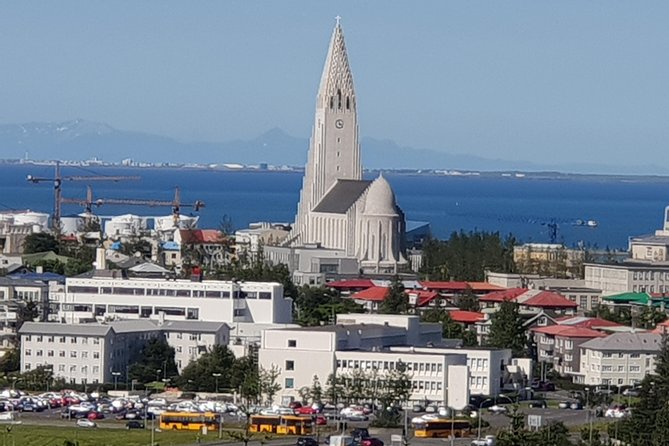
Then you land at Reykjavík itself, with the essentials of the founding story and the city’s rise.
Reykjavík traces back to 874, founded by the Norseman Ingólfur Arnarsson. It began as a small fishing village and trading post, then became the administrative center of Danish-ruled Iceland on August 8, 1786. Reykjavík officially became the capital in 1843.
One of the most practical ways this stop helps is psychological. When you’re in Iceland, distances can feel weird. This reminder—the world’s northernmost capital—puts the whole trip into perspective. You see why the city feels so important even when it’s not huge.
If you’re thinking about timing your day, this is also a good moment to check your energy. After the historical stops, you’ll start shifting into architecture and viewpoint territory.
Harpa and Reykjavik City Hall: Modern Architecture on a Human Scale
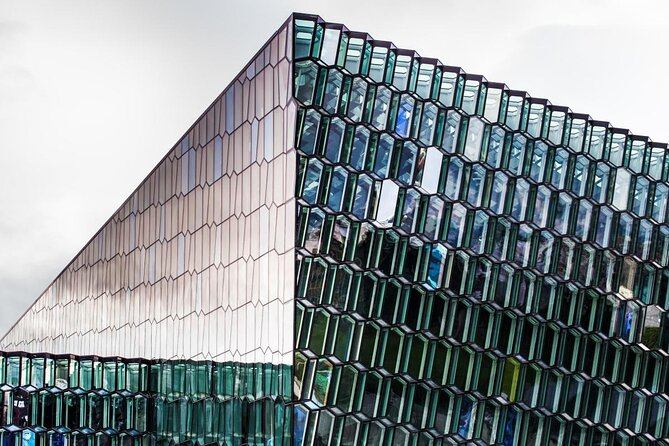
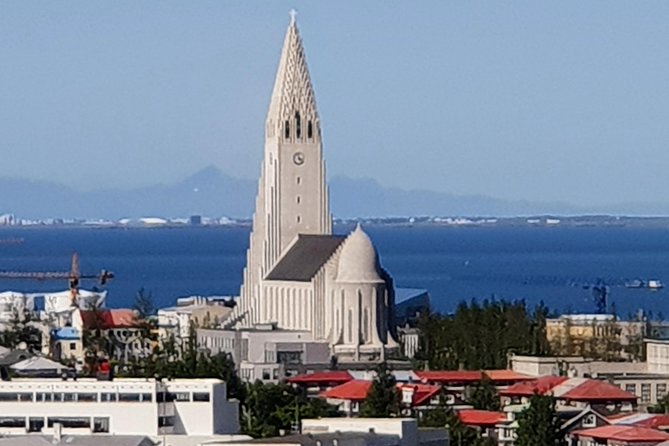
Harpa Concert Hall and Conference Centre is the kind of place you notice even from a quick approach. It sits in the heart of Reykjavik and is known for award-winning architecture. It opened on May 4, 2011, and has welcomed around 4 million guests since then.
A stop of about 20 minutes is enough to do two useful things: see the building from a couple angles and watch how people move around it. Harpa isn’t just a photo wall; it’s a social landmark. You’ll likely find yourself imagining where concerts, meetings, and events fit into the city’s rhythm.
Then you head to Reykjavik City Hall, a striking building on the northern shore of the pond in the center of the city. It’s designed to blend nature, water, and a place for birds right inside the urban setting.
For me, this pairing works well because it contrasts two forms of modern civic life:
- Harpa feels like culture and gathering.
- City Hall feels like governance and everyday public space.
Both make Reykjavik feel intentional rather than accidental.
Perlan’s Glass Dome and 61 Meters of Look-Where-You-Are Views
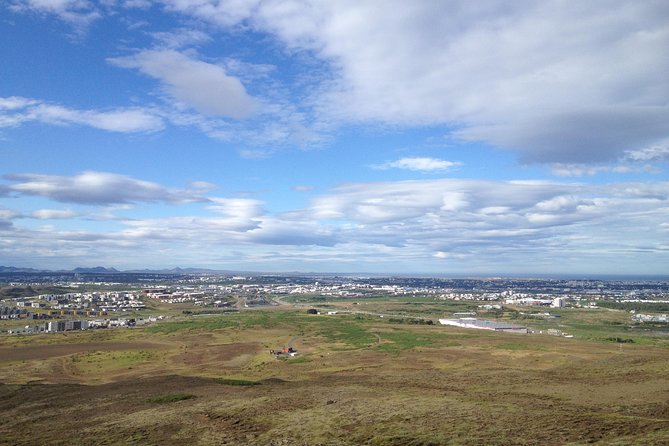
After city streets and modern halls, the tour climbs to Öskjuhlíð Hill, where Perlan—often called the Pearl—sits about 61 meters above sea level.
This is one of those stops that gives you something you can’t easily get from street level: context. When you’re up there, Reykjavik starts to make sense. You can connect the dots between neighborhoods, the coastline, and where major landmarks sit relative to each other.
Perlan is also distinctive engineering-wise. It’s a landmark building with a massive glass dome perched on six hot water tanks. That detail matters because it ties the view stop to Iceland’s geothermal reality, not just its scenic angles.
Admission is included here, so you avoid the small friction of ticketing. With around 30 minutes on the hill, aim to do two things:
1) take in the view without rushing,
2) then circle back for photos while you still have daylight on the right side of the dome.
If weather is foggy, this can still be worth it, but your photo results will depend on visibility.
Hafnarfjörður’s Harbor Legends and Viking Lore
Now you move to Hafnarfjörður, a harbor village in the greater capital area. It’s the third most populous city in Iceland, and it comes with a reputation that’s half folklore, half identity: it’s often called the town of the hidden people and Vikings.
That label isn’t just a fun tagline. It signals the vibe of the place and how residents relate to local stories. Even in a short visit (about 30 minutes), you get a sense that Hafnarfjörður isn’t trying to be Reykjavik 2.0. It feels like a different chapter in the capital region.
This stop is also a smart way to stretch your mental map. Reykjavik can feel like the whole country if you’re only touring inside it. Hafnarfjörður reminds you the region has its own character beyond the main city center.
Practical tip: use this moment to ask your guide for restaurant or pub suggestions. With the day’s context building, those recommendations tend to land better than generic tips.
Bessastaðir: Iceland’s Presidential Home and Snorri Sturluson’s Footsteps
The final major stop is Bessastaðir, the official home of the President of Iceland. This place is historically heavy, even if you only spend about 30 minutes.
Bessastaðir was first settled around the year 1000. In the 13th century, it became one of Snorri Sturluson’s farms. After Snorri was murdered, Bessastaðir was claimed by the king of Norway.
That story alone connects multiple eras—settlement, medieval Icelandic figures, and then the broader Scandinavian political shift.
Admission is included here, so you get in without extra ticket hassle. It’s also a stop that helps you end the tour with perspective. You began with Iceland’s Parliament House. You end at the presidential home. In between, you walked older neighborhoods, saw modern architecture, and got viewpoint context.
If you like your travel with a strong storyline, this closing stop is a good payoff.
How to Make the Most of the Stops in 3 to 4 Hours
Because the timing is structured, your best strategy is to travel light and focus.
I’d do three things on a tour like this:
- Start mentally with photos first, details second. You’ll get multiple exterior viewpoints and street scenes, so make sure your camera is ready.
- Use the guide for meaning, not just facts. Asking what to do later in the day—where to eat, drink, and explore—tends to get you better results than searching from scratch.
- Plan your next stop with the Wi‑Fi. While you’re traveling between locations, open a map and decide how you’ll continue once you’re done.
What I’d watch for is the short dwell time at each location. It’s enough to feel the place and get key images, but it’s not enough for museum-level immersion everywhere. If you know there’s one stop you’d want more time at—like Perlan’s viewpoint areas—save extra hours for it later.
Also, the experience depends on good weather. If conditions are poor, the tour can be moved to a different date or refunded, which is good to know when you’re planning around Iceland’s famously changeable forecasts.
Should You Book This Reykjavik Northernmost Tour?
Book it if you want a high-efficiency Reykjavik orientation with real variety: politics, old streets, modern architecture, geothermal viewpoints, and a quick jump to the capital region beyond Reykjavík.
Skip it only if you’re the type who wants long museum time, lots of deep walking, or you already have a tight plan with no need for guidance. In that case, you might prefer assembling your own route at a slower pace.
For most visitors, though, this private, up-to-4 group format hits a sweet spot. You get pickup comfort, onboard Wi‑Fi, and a guide-led storyline that turns a handful of stops into a coherent tour of Reykjavik’s identity—right down to the fact that you’re standing in the world’s northernmost capital.
FAQ
What is the duration of the Reykjavik tour?
The tour runs about 3 to 4 hours.
How much does the tour cost?
It is $650.00 per group, up to 4 people.
Is pickup included?
Pickup is offered, and you’ll be picked up from the greater capital area.
Is Wi‑Fi provided during the tour?
Yes. There is Wi‑Fi on board.
What language is the tour offered in?
The tour is offered in English.
Are tickets for the stops included?
Admission is free for several stops, while Perlan and Bessastaðir include admission as part of the tour.
Are meals included?
No. Meals are not included.
Is this a private tour?
Yes. It’s a private tour/activity, and only your group participates.
What if the weather is bad?
The experience requires good weather. If it’s canceled due to poor weather, you’ll be offered a different date or a full refund.